Highest Paying Healthcare Jobs in India for 2026:Careers Worth Chasing
"Explore the highest-paying healthcare jobs in India for 2026, from neurosurgeons and cardiologists to hospital managers, pharmacists, nurses, and clinical researchers. Compare salaries, qualifications, skills, and career paths to choose wisely."
pooja
Careers Worth Chasing
Healthcare in India isn't just growing right now; it's reshaping itself, and salaries are starting to catch up. The industry is projected to reach USD 638 billion, with growth of around 5% expected through 2030, which basically means the demand for skilled people, not just doctors, is only going to keep climbing from here. If you're a student trying to decide on a direction, or someone already working who's wondering whether healthcare is worth the jump, this is a pretty good moment to look seriously at this sector.
What's changed the most over the last couple of years, and it's a bigger shift than most people realise, is who even counts as a "healthcare professional" when the conversation turns to top salaries. The highest-paying healthcare jobs in the country are no longer limited to specialist doctors. Healthcare is also part of a much larger global picture, where specialised expertise continues to drive some of the highest-paying jobs in the world. They now stretch into healthcare management, clinical research, and medical technology just as much. That's genuinely good news if MBBS and NEET were never part of your plan, because there's a real, well-paying path forward without either of them.
Let's actually go through where the money is in 2026, starting with the clinical side and then moving into the non-doctor careers that don't get anywhere near enough attention.
The Top-Paying Clinical Specialisations
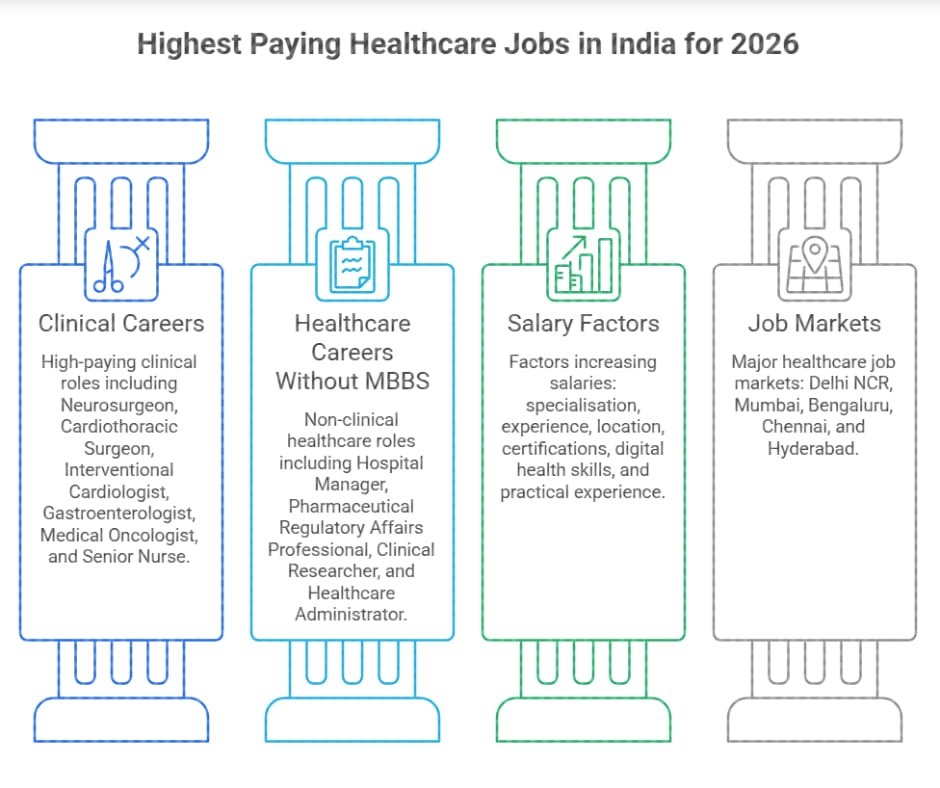
If you've already got an MBBS, or you're planning one, specialisation is where the real jump in earnings happens. Super specialist doctors, people like neurosurgeons, cardiothoracic surgeons, interventional cardiologists, medical oncologists, gastroenterologists, and urologists, sit among the highest earners in the country, and it comes down almost entirely to the years of advanced training behind them and the sheer demand for what they do.
Neurosurgery tends to sit right at the top of most salary lists in Indian healthcare, and honestly, it's not hard to see why. These are specialists operating on the brain, spine, and nervous system, procedures that demand years of precision training and carry a level of responsibility most other careers simply don't touch. The road there is a long one too: MBBS, then MS, then MCh, easily eight to twelve years of study before anyone's practising independently. But the payoff at senior levels in top private hospitals is substantial enough that the years tend to feel worth it in hindsight.
Cardiology, particularly the interventional side, is another strong earner, where procedure volume and complexity push income up fast once a doctor builds a reputation. Gastroenterology consistently ranks among the highest-paying specialisations nationally too, alongside plastic and cosmetic surgery, where private practice and elective procedures often push earnings well past what a standard hospital salary would offer. Oncology, both medical and surgical, keeps growing in demand simply because of how many patients now need long-term treatment, and orthopedics along with interventional radiology are seeing similar momentum as lifestyle-related injuries and chronic conditions rise across urban India.
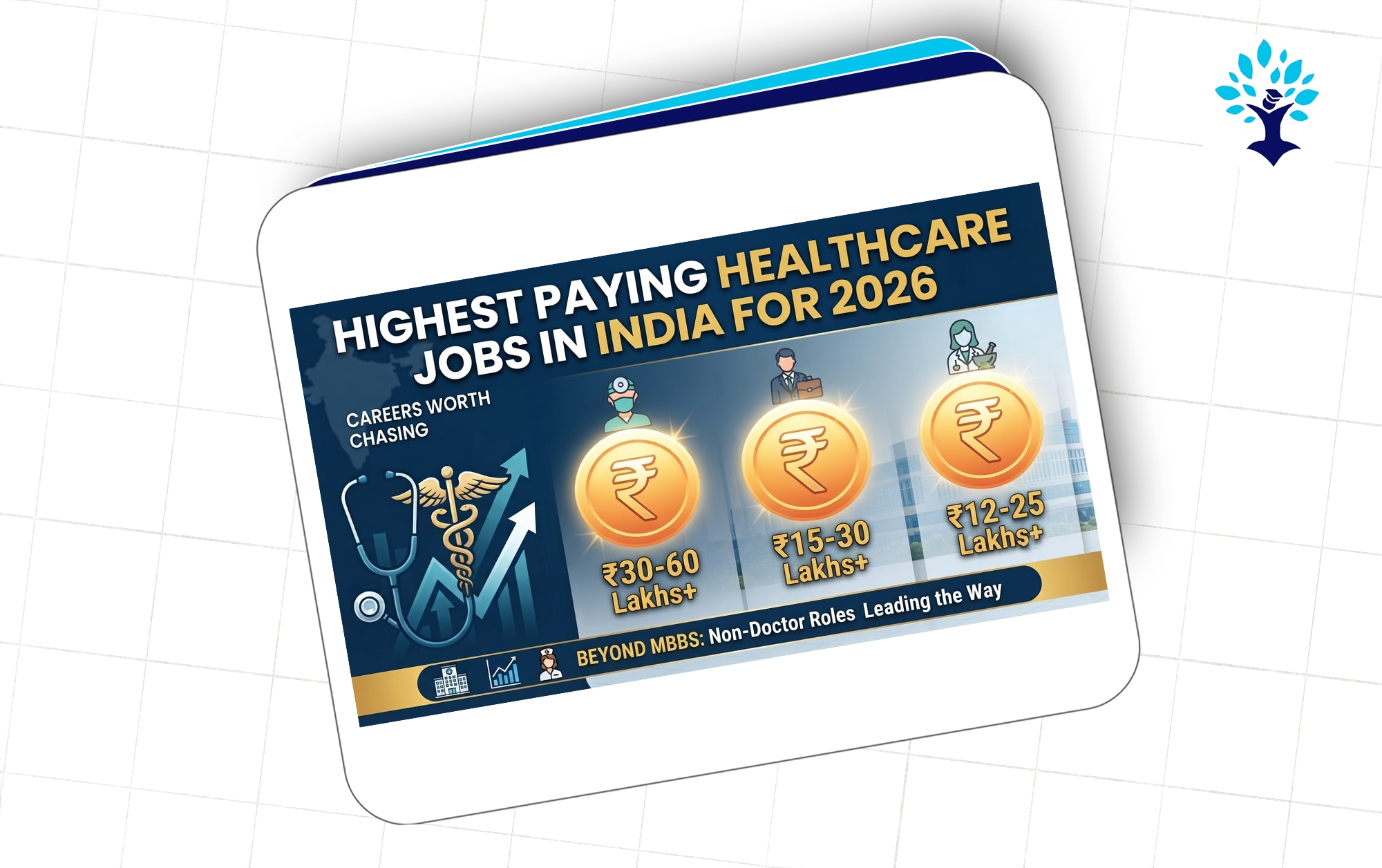
Based on current projections, neurosurgeons, cardiothoracic surgeons, and anesthesiologists top the list, with salaries at senior levels in reputed hospitals ranging roughly between ₹30 and ₹60 lakhs annually, and that figure climbs considerably higher for doctors who've built successful private practices in metro cities.
Where You Practice Changes Everything
Location isn't some minor detail in Indian healthcare salaries; it's actually one of the biggest levers there is. Cities with established hospital networks, medical colleges, research institutes, and healthcare technology companies consistently offer better growth and higher pay, which is exactly why Delhi NCR, Mumbai, Bangalore, Chennai, and Hyderabad keep showing up as the top-paying markets, whether you're looking at clinical roles or the non-clinical side of things.
That said, there's a trade-off here worth being upfront about, because it trips up a lot of people. Metro salaries look impressive on paper right up until rent enters the picture, and plenty of professionals end up doing the actual math on whether a tier-2 city with a somewhat lower salary but a much lower cost of living leaves them better off by the end of the month. There isn't one right answer to this. It genuinely depends on the specialisation, the stage of career someone's at, and honestly, how much of a premium they place on metro-city life in the first place.
High-Paying Careers That Don't Require an MBBS
This is the part of the healthcare salary conversation that deserves a lot more attention than it usually gets, because most people assume the top paycheques in this field belong exclusively to doctors. That's simply not true anymore. You don't need to have cleared NEET or completed an MBBS to build a genuinely high-paying career in healthcare in 2026. Healthcare is only one example of this shift, with plenty of high-paying careers for non-engineers now available across industries where specialised skills matter more than an engineering degree.
Hospital and healthcare management is one of the clearest examples of this. A background in health administration, or an MBA with a healthcare specialisation, can lead straight into hospital operations, and senior hospital managers in metro cities routinely earn somewhere between ₹70,000 and ₹1,50,000 a month, with entry-level administrative roles usually starting closer to ₹25,000 to ₹50,000 and building from there.
Pharmacy pays far better than most people expect once you climb a few rungs up the ladder. Drug regulatory and medical affairs roles at MNC pharma companies like Pfizer India, AstraZeneca, and Abbott Healthcare are among the highest-paying pharmacist career paths in the country, with total packages reaching ₹20 to ₹35 lakhs annually for experienced professionals. Getting there usually means a B.Pharm followed by an M.Pharm for the more advanced regulatory and clinical roles, but the ceiling is genuinely high for someone who sticks with it.
Nursing has seen a real shift too, especially at the senior end of the career. A staff nurse at a Tier-1 private hospital in a metro city typically earns somewhere around ₹20,000 to ₹35,000 a month, while head nurses and nursing supervisors move up into the ₹40,000 to ₹70,000 range. Nurse practitioners who specialise in areas like critical care, oncology, or neonatal ICU tend to command a real premium above that, and international nursing opportunities, particularly across the Gulf and parts of Europe, add another meaningful layer of earning potential for nurses open to relocating.
Clinical research and medical technology round out the list of strong non-clinical earners. Roles like medical scientists, clinical researchers, and healthcare administrators support diagnosis, research, and day-to-day hospital operations, and they tend to offer stable, steady growth rather than the sharper spikes you see in clinical practice. With India increasingly becoming a hub for global clinical trials and pharmaceutical research, this particular space is only going to keep expanding over the next few years.
Skills That Actually Move the Needle on Salary
A degree by itself rarely gets anyone to the top of the pay scale anymore, whether you're on the clinical side or not. Short-term courses in medical coding, clinical research, AI in healthcare, or regulatory affairs boost employability considerably, and they're often the exact thing that separates a candidate who gets shortlisted for the better-paying roles from one who doesn't, even when both have similar base qualifications on paper. The same principle applies outside healthcare too, where focused technical skills can take someone from having little relevant experience to building a career in areas such as cloud computing, as shown by the journey from zero to cloud job.
If you're trying to push your earning potential up in this field, a few things are worth focusing on early. Certifications in medical coding or clinical research open real doors into pharma and health-tech companies that tend to pay well above standard hospital salaries. Getting comfortable with digital health tools matters too, since familiarity with Electronic Health Records systems, telemedicine platforms, and diagnostic AI tools is becoming close to a baseline expectation in modern hospital settings rather than a nice-to-have. And internships or hands-on time spent in hospitals, labs, or pharma companies early in your career build both the domain knowledge and the kind of network that ends up bringing in referrals down the line, which matters more in healthcare hiring than people tend to expect.
Final Thought
Healthcare in India in 2026 isn't a single career path anymore; it's a whole ecosystem of them, and the highest-paying roles aren't reserved only for doctors who spent a decade in medical college. Whether you're leaning toward a clinical specialisation, hospital management, pharmacy, nursing, or clinical research, the sector has genuine room to grow and genuinely competitive pay if you pick a lane and build real expertise in it rather than spreading yourself thin. Choose based on where your actual interest sits, then stack the right certifications and hands-on experience on top of it, because in this field, that combination decides your salary far more than the degree hanging on your wall ever will.
Related Articles

10 Resume Mistakes That Are Quietly Costing You Every Interview
"Discover the 10 common resume mistakes that silently cost candidates interviews. Learn how to improve your resume, stand out to recruiters, and increase your chances of landing more job opportunities."
6 min read

Your LinkedIn Profile Is Working a Night Shift — Make Sure It's Actually Good at the Job
"Recruiters spend just seconds reviewing LinkedIn profiles. Learn how to Optimize your photo, headline, About section, skills, and experience to increase profile views, recruiter interest, and job opportunities."
6 min read

Should You Let AI Write Your Resume? Here's the Honest Answer Nobody's Giving You
"Everyone's using AI to write resumes—but should you? Here's the honest truth about what AI gets right, where it backfires, and how to create a resume that impresses both ATS systems and human recruiters."
7 min read